Laboratory of Multi-omic Integrative BioinformaticsArtificial intelligencefor molecular biology

By leveraging breakthrough advances in the fields of artificial intelligence and statistical modelling, our group aims to develop novel computational methodologies for data fusion and pattern recognition and apply them to further our understanding of human disease.

Our approach

Modern life science research is a highly multidisciplinary endeavor often requiring the joint analysis of highly heterogeneous data sources, such as large-scale single-cell multi-omics datasets, structured ontology-driven annotations, unstructured published literature and imaging data. Using a holistic approach, one can often detect patterns which provide deeper insights into the biological and/or pathophysiological processes under study. However, such data analysis approaches are complex when dealing with heterogeneous and highly dimensional datasets.

Research

Decoding the complexity of biological systems

All research

01Multi-omic and spatial data integration

Question

Modern technologies measure different molecular species on the same biological sample. How do these layers jointly describe the state of a cell or a tissue, beyond what any single modality reveals?

Approach

Modality-agnostic deep generative models that learn shared low-dimensional representations while correcting for technical artefacts, together with the preprocessing, alignment and benchmarking needed to evaluate them reproducibly.

About this theme
02Explainable AI for multi-omic representation learning

Question

Which genes, regulators and molecular features does a model actually rely on, and can what it has learned be turned into testable biological hypotheses?

Approach

Feature-attribution methods that respect dependencies between inputs. Causal Integrated Gradients routes attributions along prior causal structure, such as a transcription factor regulating its target gene, and separates direct from mediated effects.

About this theme

03Subcellular RNA organisation and spatial transcriptomics

Question

Where does an mRNA molecule sit inside a cell, and what does its localisation tell us about post-transcriptional regulation? And which genes should a targeted spatial experiment measure in the first place?

Approach

Self-supervised representation learning on per-cell images of transcript localisation, with a probabilistic framework for pattern detection, and an evidence-based look at how gene panels are chosen for targeted spatial transcriptomics.

About this theme

04Genetic perturbation of the cellular lipidome

Question

Which genes shape the lipid composition of a cell, and how do cells buffer the consequences when lipid metabolism is genetically perturbed?

Approach

A multimodal perturbation screen that reads out lipidome and guide-RNA identity from the same single cells, and the joint computational analysis of these lipidomic responses with transcriptomes from matched perturbations.

About this theme

05Genetic architecture of human disease

Question

Of the millions of variants in a patient's genome, which ones cause disease, for example in congenital heart disease, and how does genetic variation act through gene regulation?

Approach

Deep learning models that integrate variant features, gene expression and patient phenotypes to prioritise candidate variants, and neural networks that predict chromatin accessibility from long-read sequencing data.

About this theme

06Single-cell and spatial biology with LISCO partners

Question

How do cell types and cell states change in disease and in tissue remodelling, from glia in ALS and neurons in Alzheimer's disease to the gut and the skin?

Approach

End-to-end single-cell and spatial analysis, from raw count matrices to biologically validated cell-type signatures, and image-based deep learning built together with experimental partners.

About this theme
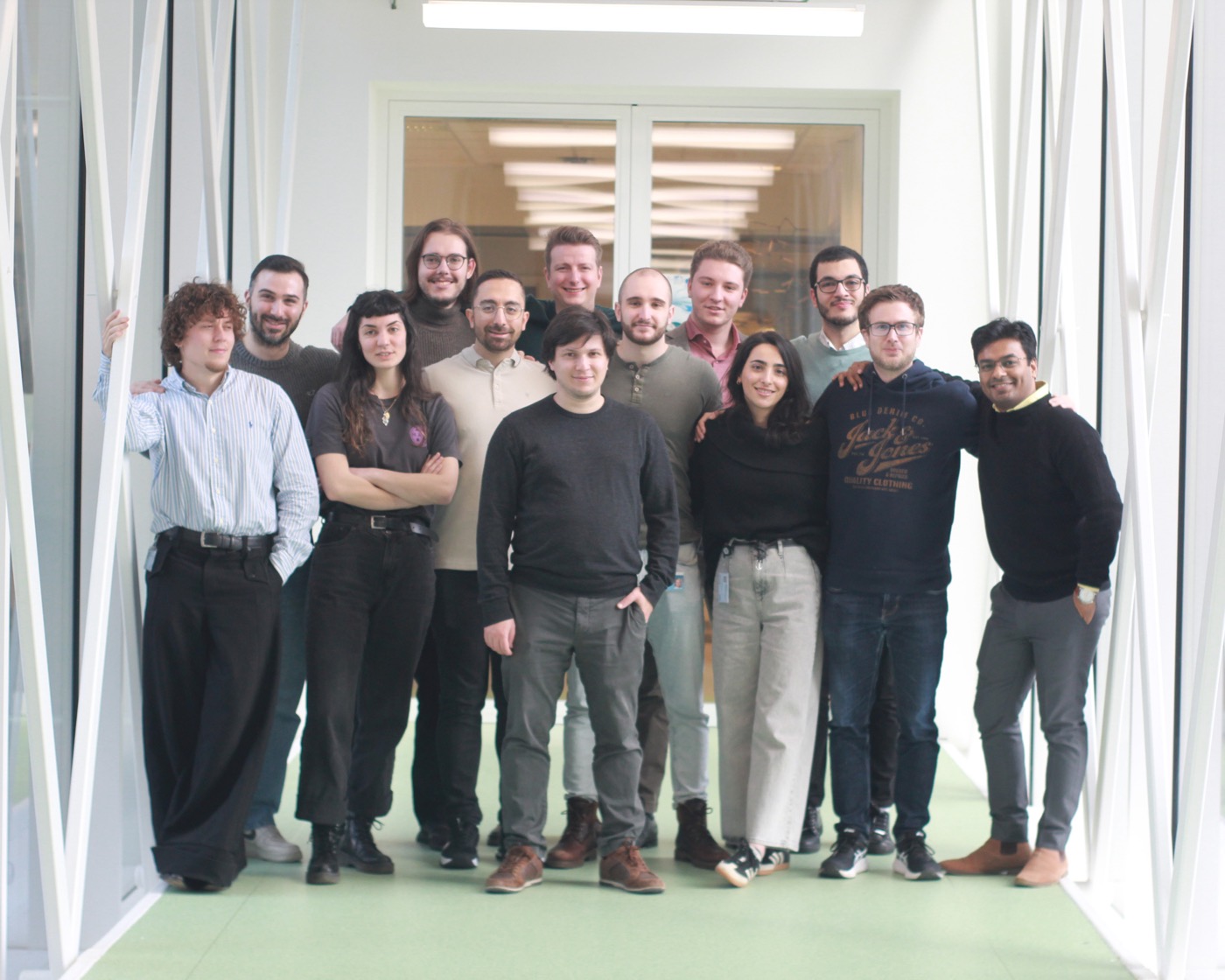
Members of the Laboratory of Multi-omic Integrative Bioinformatics

People

A team from many disciplines

We are a team of enthusiastic researchers from all walks of life that want to push the frontier of bioinformatics. Our postdocs and PhD students come from biomedical science, bioinformatics, engineering and computer science, and we strive to build an inclusive and collaborative environment for research.