Introducing FOCUS, a framework for preprocessing, alignment, and integration of spatial multi-omics data.
We are excited to share our colleague Lorenzo’s latest preprint: FOCUS, an end-to-end Python Framework for preprocessing, alignment, and resolution-matched integration of spatial multi-omics data.
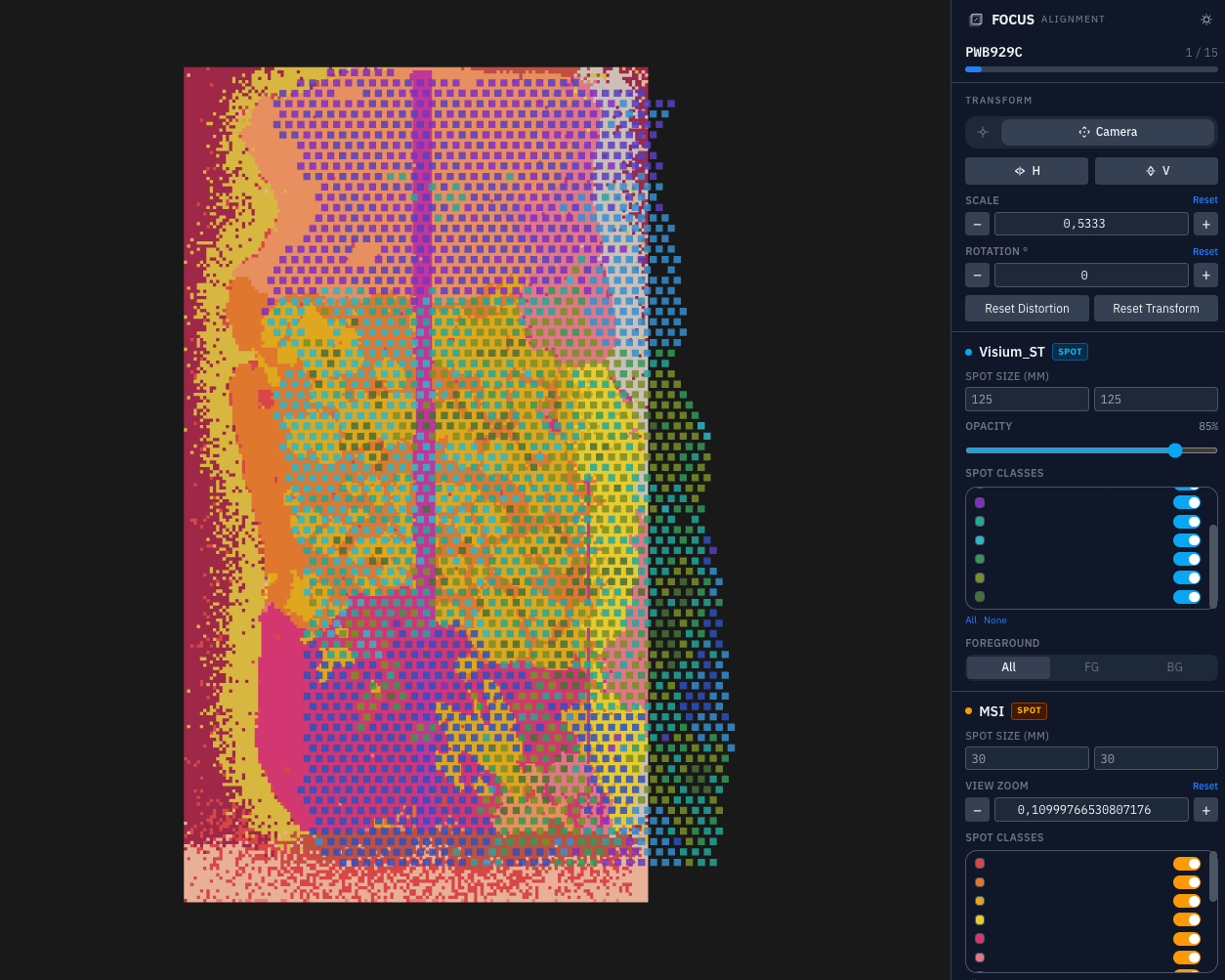
Spatial assays profile the same tissue across complementary molecular layers, but joining them requires every observation to sit on a common spatial index, and the assays differ in file format, coordinate system, spatial resolution, and preprocessing convention. Reconciling these differences by hand is the step that stands between a set of experimental acquisitions and an analysis-ready dataset. FOCUS is designed for exactly that step: it returns molecular layers already preprocessed, aligned and resolution-matched on a shared observation grid, ready both for standard downstream analysis and for the growing number of published AI-based multimodal integration frameworks with minimal manual data preparation. FOCUS covers the full path from experimental files to an analysis-ready object, supporting spatial transcriptomics, mass spectrometry imaging, Raman spectroscopy imaging and brightfield or fluorescence microscopy.
It aligns modality pairs that share no identifiable landmarks through an interactive browser-based interface that keeps the alignment step tractable for cross-technology and serial-section data. It resolves the resolution mismatch between assays, mapping every target modality and pathologist-drawn region annotations onto a shared observation grid. It returns a single scverse-compatible MuData object from a command-line interface, a browser GUI, or a Python API, and extends to further modalities and registration methods through a registry-based architecture.
The preprint and code are openly available.