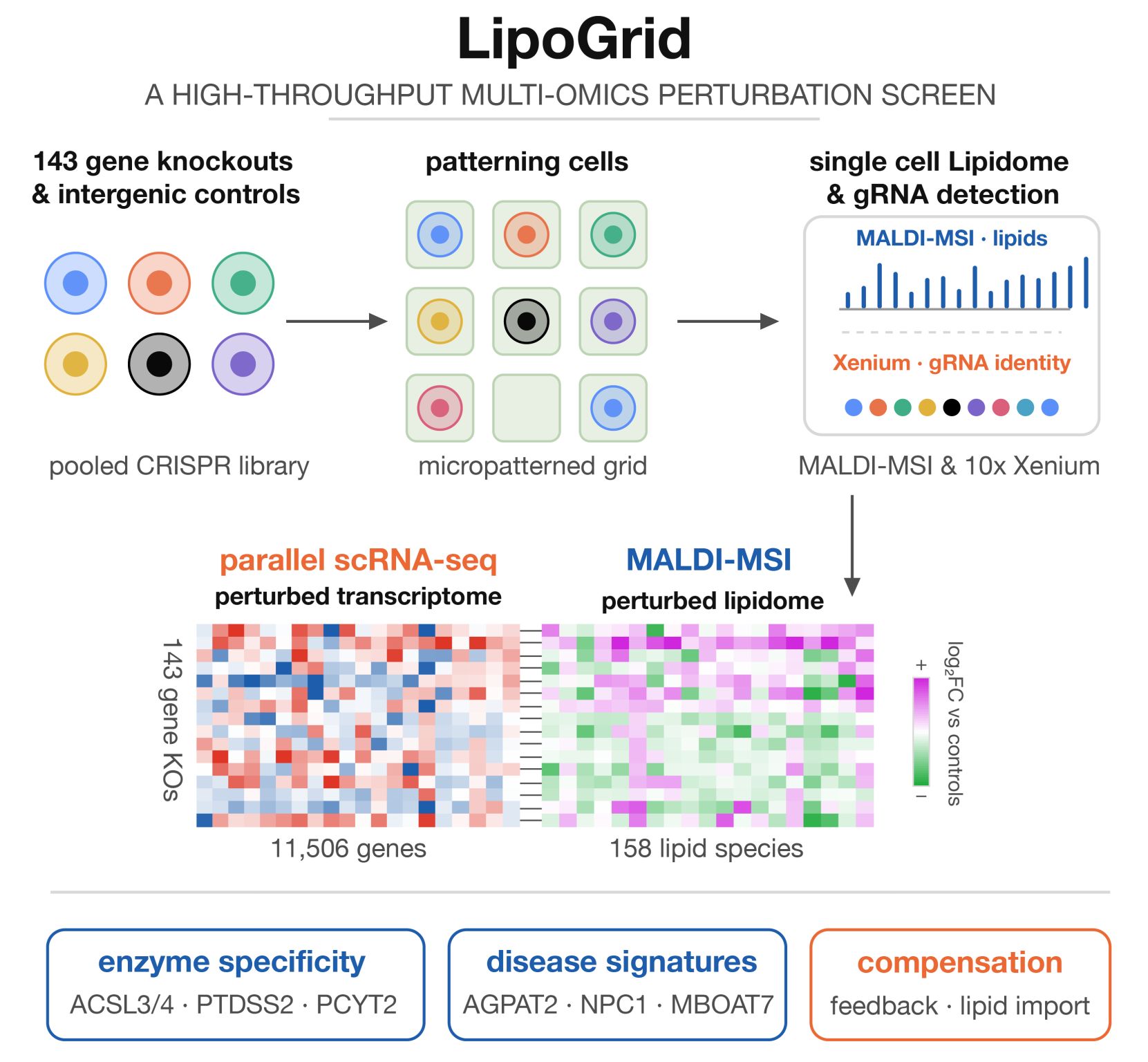
Introducing LipoGrid, a high-throughput multi-omics perturbation screen to dissect the genetic architecture of lipid metabolism.
Excited to share the latest preprint led by our colleague Jelle: LipoGrid, a high-throughput multi-omics perturbation screen dissects the genetic architecture of lipid metabolism.
Lipids are extraordinarily diverse and central to cellular function, yet we still have a limited understanding of the genetic mechanisms that shape the cellular lipidome. A major challenge has been the lack of scalable approaches that can connect defined genetic perturbations to changes in lipid composition. LipoGrid addresses this gap.
LipoGrid combines CRISPR perturbations in micropatterned cells with spatial mass spectrometry and downstream gRNA identification. This allows us to systematically connect gene perturbations to changes in specific lipid species, which we further integrate with transcriptomic profiles from matched perturbations.
In our first screen, we mapped 143 gene knockouts to 158 lipid species, revealing:
- Widespread but highly specific remodeling of the lipidome following gene perturbation
- Enzyme-substrate specificities and disease-associated lipid signatures
- Compensatory feedback mechanisms that buffer changes in lipid metabolism
- Lipid-class-specific uptake and remodeling
Together, these results show that spatial single-cell lipidomics, combined with transcriptomics, can systematically uncover the genetic architecture of lipid homeostasis.
We hope LipoGrid will provide a foundation for exploring how genetic perturbations reshape the lipidome and for connecting lipid metabolism more directly to disease mechanisms.
If you are interested in lipid metabolism, functional genomics or spatial omics, we would be very happy for you to explore the preprint and interactive browser:
This was a true collaborative effort of 5 KU Leuven teams from LISCO-Biomed, Thierry Voet, Jeroen Lammertyn, Johan(nes) Swinnen, Bernard Thienpont and Alejandro Sifrim. Led by Jelle Jacobs with essential expertise provided by, co-first author Paulien Van Minsel, Nina Ravoet, Emiel De Rieck, Niels Vandermeulen, Lorenzo Venturelli, Katy Vandereyken, Karen Ven, Jolien Breukers and David Wouters.